
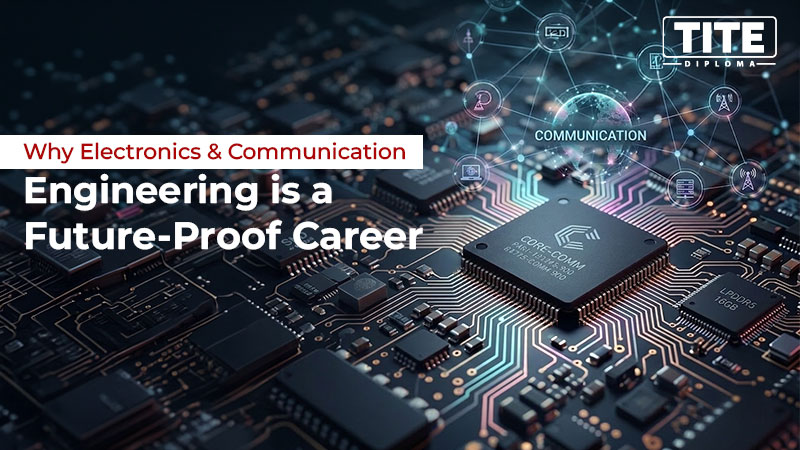
Why Electronics & Communication Engineering is a Future-Proof Career
Summary: Technology is reshaping every industry, and Electronics & Communication Engineering is at the center of this transformation. From smart devices and 5G networks to automation and AI-powered systems, skilled ECE professionals are driving innovation across the globe. For students looking for a career that combines stability, growth and endless learning opportunities, ECE offers a pathway filled with exciting possibilities.
Technology is no longer confined to smartphones and computers, it powers intelligent homes, autonomous vehicles, smart factories, wearable healthcare devices and connected cities. Innovations such as the Internet of Things, 5G networks and the upcoming era of 6G rely on robust electronic systems and seamless communication technologies, making Electronics & Communication Engineering one of the most relevant engineering disciplines today. For students exploring Electronics and communication diploma colleges in Bhubaneswar, this field offers an exciting opportunity to build the technologies that are transforming industries and everyday life. Rather than being replaced by innovation, ECE professionals are the ones driving it forward.
Electronics & Communication Engineering combines hardware design, software integration and systems thinking to create resilient career opportunities across telecommunications, automation, healthcare, consumer electronics, aerospace and emerging technologies. Whether you are a student planning your future or a parent seeking a career with long-term stability, ECE continues to stand out as a future-focused choice. Institutions like TITE Diploma provide industry-oriented diploma programs that help learners build practical skills and prepare for the evolving demands of the global technology landscape.
What Is Electronics & Communication Engineering?
Electronics & Communication Engineering is a branch of engineering that focuses on designing, developing, testing, and maintaining electronic devices, communication systems and intelligent technologies that enable modern connectivity. It forms the foundation of innovations such as smartphones, wireless networks, satellite communication, medical equipment, smart appliances, robotics and Internet of Things (IoT) devices. Students enrolled in Diploma in ECE colleges in Odisha gain a balanced understanding of both electronics hardware and communication technologies, preparing them for careers in industries that are rapidly embracing digital transformation.
The curriculum of ECE combines theoretical knowledge with practical applications across a wide range of subjects. Core areas of study include Analog Electronics, Digital Electronics, Signals and Systems, Communication Engineering, Microprocessors and Microcontrollers, Embedded Systems, VLSI (Very Large Scale Integration), Digital Signal Processing (DSP), Wireless Communication and PCB Design. Through laboratory sessions, industrial projects and technical workshops, students learn how electronic circuits are designed, how data is transmitted over communication networks and how embedded systems power today's smart devices.
Although ECE shares similarities with other engineering disciplines, it has a distinct focus. Computer Science primarily deals with software development, programming, algorithms, databases and artificial intelligence, whereas Diploma in ECE integrates software with electronic hardware to create intelligent systems. Electrical Engineering is largely centered on power generation, transmission, electrical machines and energy systems, while Electrical and Electronics Engineering combines electrical power concepts with electronic devices. In contrast, Electronics & Communication Engineering specializes in electronic circuits, communication technologies, semiconductor devices, embedded hardware, wireless networks and integrated systems. This interdisciplinary nature allows ECE graduates to work across diverse industries, making it one of the most versatile and future-ready engineering fields.
Key Technology Drivers Making ECE Future-Proof
The rapid evolution of technology is creating unprecedented opportunities for Electronics & Communication Engineering (ECE) professionals. From next-generation communication networks to intelligent devices and advanced semiconductor manufacturing, ECE lies at the heart of every major technological breakthrough. Students exploring Private ECE diploma colleges in Bhubaneswar should understand that the skills learned today will remain relevant as industries continue to embrace digital transformation and automation.
5G/6G and Telecom Infrastructure
The global rollout of 5G has transformed the way people and devices communicate by enabling ultra-fast data transfer, low latency, and reliable connectivity. Industries such as healthcare, manufacturing, transportation, and entertainment are already leveraging 5G to power remote surgeries, autonomous vehicles, smart factories, and immersive digital experiences. Research into 6G has also begun, promising even faster communication speeds and AI-integrated networks. ECE professionals are responsible for designing communication systems, RF circuits, antennas, base stations, and network infrastructure that make these technologies possible.
Internet of Things (IoT) and Edge Computing
From smart homes and wearable fitness trackers to industrial sensors and connected agriculture, the Internet of Things (IoT) is rapidly expanding. Edge computing complements IoT by processing data closer to the device, reducing latency and improving efficiency. ECE engineers design the embedded hardware, communication modules, sensors, and wireless systems that enable billions of connected devices to exchange information securely and efficiently.
Embedded Systems and Robotics
Embedded systems serve as the "brains" of countless electronic products, including automobiles, drones, medical devices, industrial machines, and consumer electronics. As robotics and automation continue to reshape manufacturing, logistics, healthcare, and defense, skilled ECE professionals are needed to develop microcontroller-based systems, control electronics, and real-time embedded applications that keep these technologies operating reliably.
Semiconductor Resurgence and VLSI Design
Semiconductors are the foundation of every electronic device. Governments and technology companies worldwide are investing heavily in semiconductor manufacturing and chip design to strengthen supply chains and support future innovations. This has created strong demand for professionals skilled in VLSI (Very Large Scale Integration), chip testing, PCB design, fabrication processes, and integrated circuit development. ECE graduates with semiconductor expertise are expected to play a vital role in this rapidly growing industry.
AI/ML Hardware Accelerators (ASICs & FPGAs)
Artificial Intelligence and Machine Learning require specialized hardware to process massive amounts of data efficiently. Technologies such as Application-Specific Integrated Circuits (ASICs) and Field-Programmable Gate Arrays (FPGAs) are increasingly used in AI servers, autonomous vehicles, medical imaging systems, and cloud computing infrastructure. Electronics & Communication engineers contribute to designing, testing, and optimizing these hardware accelerators, making AI faster, more energy-efficient, and scalable.
Renewable Energy and Smart Grids
The transition toward sustainable energy has increased the need for intelligent electronic systems capable of monitoring and managing power distribution. Smart grids, solar power plants, wind energy systems, electric vehicle charging stations, and battery management systems all depend on advanced electronics, sensors, communication protocols, and embedded controllers. ECE professionals help develop these technologies to improve energy efficiency, reliability, and environmental sustainability.
Key Industry Growth Statistics | Key Indicators
- Internet of Things (IoT) Market: According to Grand View Research, the global IoT market is valued at USD 1.59 trillion (2025) and is projected to reach USD 3.27 trillion by 2033, growing at a CAGR of 8.9%. This growth is driven by smart homes, connected healthcare, industrial automation, and smart cities.
- 5G IoT Market: The global 5G IoT market is expected to grow from USD 7.72 billion (2024) to USD 89.42 billion by 2030, registering a remarkable 50.3% CAGR. The expansion of 5G networks is creating significant demand for ECE professionals in telecom infrastructure and wireless communication.
- Global Semiconductor Industry: According to the Semiconductor Industry Association (SIA), worldwide semiconductor sales reached a record USD 791.7 billion in 2025 and are expected to approach USD 1 trillion in the coming years, fueled by AI, automotive electronics, IoT, and advanced computing.
- IoT Devices Market: The global IoT devices market is projected to increase from USD 70.3 billion in 2024 to USD 181.17 billion by 2030, growing at a CAGR of 16.8%, indicating a rising need for embedded systems and electronics engineers.
- Industrial Robotics: As per the findings of International Federation of Robotics, more than 4.2 million industrial robots are currently operating in factories worldwide, with annual installations continuing to grow as industries adopt Industry 4.0 and smart manufacturing.
- Artificial Intelligence (AI) Market: The global AI market is expected to grow from USD 391 billion in 2025 to over USD 1.8 trillion by 2030, increasing the demand for AI hardware accelerators, ASICs, FPGAs, and embedded computing solutions developed by ECE professionals.
Career Paths & Job Roles in Electronics & Communication Engineering
An Electronics & Communication Engineering diploma opens the door to a wide range of career opportunities across telecommunications, semiconductor manufacturing, consumer electronics, automotive, healthcare, aerospace and industrial automation. Students graduating from a Diploma in ECE colleges in Odisha are not restricted to a single career path; they can specialize in emerging technologies or transition into multidisciplinary roles as industries evolve.
Core Industry Roles
ECE professionals are in demand for several specialized technical positions, including:
- RF Engineer: Designs and optimizes radio frequency systems used in mobile networks, satellite communication, radar systems and wireless devices.
- Communication Systems Engineer: Develops and maintains wired and wireless communication infrastructure, including 5G/6G networks and optical communication systems.
- Embedded Systems Engineer: Designs microcontroller and processor-based systems for IoT devices, medical equipment, automotive electronics and smart appliances.
- VLSI Design Engineer: Works on designing, verifying and testing integrated circuits and semiconductor chips used in modern electronic devices.
- Test & Validation Engineer: Ensures electronic products meet quality, safety and performance standards through rigorous testing and troubleshooting.
- Network Engineer: Installs, configures and manages enterprise and telecom networks to ensure secure and uninterrupted communication.
- FPGA Developer: Develops programmable hardware solutions for AI, aerospace, defense, telecommunications and high-performance computing applications.
Cross-Domain Career Opportunities
The interdisciplinary nature of ECE enables graduates to work beyond traditional electronics roles. Popular cross domain careers include:
- Hardware – Software Integration Engineer
- AI Hardware & Edge Computing Engineer
- Cybersecurity Engineer for Embedded Systems
- IoT Solutions Architect
- Robotics & Automation Engineer
- Product Manager for Electronics and Technology Companies
These roles combine electronics knowledge with software, data and systems engineering, offering excellent career growth.
Career Options Beyond Engineering
ECE graduates also find rewarding careers outside core engineering, especially if they possess strong communication and analytical skills. Opportunities include:
- Technical Sales Engineer: Promotes advanced electronic products and industrial solutions while providing technical support to clients.
- Patent Examiner / Intellectual Property Analyst: Evaluates innovations and patent applications related to electronics and communication technologies.
- Technical Content Writer: Creates user manuals, product documentation, engineering blogs, technical training materials and educational content for technology companies and institutions.
These careers are ideal for students, career changers and professionals who wish to stay connected with technology without working exclusively in product development.
Career Progression & Salary
| Career Stage | Experience | Job Roles | Key Responsibilities | Expected Salary | Skills Required | Career Growth |
|---|---|---|---|---|---|---|
| Entry Level | 0–2 Years | Junior Electronics Engineer, Electronics Technician, Embedded Trainee, Network Support Engineer, Field Service Engineer, Production Engineer, Test Engineer | Assist in circuit testing, PCB assembly, troubleshooting electronic systems, equipment installation, preventive maintenance, network configuration, product testing, quality inspection, and documentation under senior engineers. | ₹3 – ₹5 LPA | Basic electronics, circuit analysis, digital electronics, communication systems, PCB fundamentals, microcontrollers, troubleshooting, MS Office, communication skills | Gain practical experience, industry certifications (Embedded Systems, CCNA, IoT), and transition into specialized engineering roles. |
| Mid-Level | 3–7 Years | Embedded Systems Engineer, RF Engineer, Communication Systems Engineer, VLSI Engineer, FPGA Developer, Network Engineer, Automation Engineer, Validation Engineer | Design embedded hardware, develop firmware, optimize communication networks, validate products, work on semiconductor projects, manage client requirements, mentor junior engineers, and contribute to product development. | ₹6 – ₹8 LPA (Specialized VLSI/Embedded roles may reach ₹10 LPA) | Embedded C/C++, Verilog/VHDL, MATLAB, FPGA tools, IoT platforms, wireless communication, PCB design, debugging, project management | Move into technical leadership, architecture, product engineering, R&D, or domain specialization in AI hardware, automotive electronics, or semiconductor design. |
| Senior Level | 8–15 Years | Senior Embedded Engineer, Technical Lead, Principal Engineer, Solution Architect, Engineering Manager, R&D Manager, Product Development Manager | Lead engineering teams, design complex electronic systems, oversee product life cycles, manage cross-functional projects, define technical strategy, mentor engineers, coordinate with global clients, and drive innovation. | ₹9 – ₹17 LPA | Technical leadership, system architecture, semiconductor design, AI hardware integration, cloud-connected devices, budgeting, stakeholder management, strategic planning | Progress to Engineering Director, Head of R&D, Product Head, Chief Technology Officer (CTO), or establish a technology startup or consulting firm. |
Employability: Skills Employers Want
The demand for Electronics & Communication Engineering (ECE) professionals is growing rapidly, but employers today look beyond academic qualifications. They seek candidates who can apply theoretical knowledge to real-world engineering challenges, collaborate effectively in multidisciplinary teams and continuously adapt to emerging technologies. Students studying at Private ECE diploma colleges in Bhubaneswar can significantly improve their employability by building a balanced portfolio of technical expertise, practical experience and professional skills.
Core Technical Skills
Recruiters across electronics, telecommunications, semiconductor and embedded systems industries commonly look for the following technical competencies:
- Circuit Design and Electronic Troubleshooting
- Analog and Digital Electronics
- Signal Processing and Digital Communication
- Embedded Systems Programming
- Microcontrollers (Arduino, STM32, PIC, ESP32)
- Programming Languages: C, C++ and Python
- Hardware Description Languages (HDLs): Verilog and VHDL
- PCB Design using tools like KiCad or Altium
- IoT Platforms and Sensor Integration
- Basic Networking and Wireless Communication Concepts
Essential Soft Skills
Technical knowledge alone is not enough to succeed in today's workplace. Employers also value professionals who can:
- Solve complex engineering problems systematically
- Think beyond individual components and understand complete systems
- Communicate technical ideas clearly with teams and clients
- Work collaboratively in multidisciplinary projects
- Adapt quickly to new tools and technologies
- Manage time and prioritize project deadlines effectively
How to Build These Skills
Students can strengthen their profiles through continuous practical learning. Some effective ways include:
- Complete internships with electronics, telecom, or manufacturing companies.
- Build hands-on projects such as smart home automation, IoT weather stations, robotic vehicles, or wireless sensor networks.
- Participate in hackathons, robotics competitions, and engineering exhibitions.
- Contribute to open-source hardware and embedded software projects on GitHub.
- Earn certifications from trusted platforms such as NPTEL, Coursera, Cisco Networking Academy, Texas Instruments, ARM Education or Intel Edge AI Academy.
6-Month Beginner Learning Roadmap
| Month | Focus Area | Mini Project |
|---|---|---|
| Month 1 | Learn Analog & Digital Electronics, basic C Programming | LED blinking circuit using Arduino |
| Month 2 | Microcontrollers and Sensors | Digital Temperature Monitoring System |
| Month 3 | Embedded Systems and IoT Basics | Smart Home Light Control using ESP32 |
| Month 4 | Python, Communication Protocols (UART, SPI, I2C) | IoT Weather Monitoring System |
| Month 5 | PCB Design, Verilog/VHDL Fundamentals | Design a simple digital counter or PCB for an IoT device |
| Month 6 | Portfolio Development, GitHub, Resume, Mock Interviews | Smart Security System, Line-Following Robot, or Home Automation Project |
Education Pathways & Specialisations
A career in Electronics & Communication Engineering (ECE) offers multiple learning pathways, allowing students to continuously upgrade their knowledge as technology evolves. Students beginning their journey at Electronics and communication diploma colleges in Bhubaneswar can either enter the workforce after completing their diploma or pursue higher education through lateral entry into a B.Tech/B.E. program. This flexible academic progression enables learners to gain practical industry experience while keeping doors open for advanced technical and research careers.
After earning a bachelor's degree, students can further specialize through M.Tech/M.E., M.Sc., or even Ph.D. programs in areas aligned with emerging technologies. During undergraduate studies, choosing electives such as Embedded Systems, Internet of Things (IoT), Artificial Intelligence, Wireless Communication, Digital Signal Processing (DSP), VLSI Design, Robotics, FPGA Design or Optical Communication helps build expertise in high-demand domains.
Some of the most sought-after industry specialisations include:
- VLSI & Embedded Systems Design: Chip design, FPGA development, microcontrollers, ASICs and semiconductor technologies.
- Wireless Communications: 5G/6G networks, RF engineering, antenna systems, satellite communication and mobile technologies.
- Digital Signal Processing (DSP): Audio, video, image processing, speech recognition and communication systems.
- Robotics & Control Systems: Industrial automation, autonomous robots, mechatronics and intelligent manufacturing.
- Optoelectronics & Photonics: Fiber-optic communication, laser systems, optical sensors and high-speed communication networks.
Apart from formal education, short-term certification programs significantly improve employability. Students can enroll in industry-recognized courses offered through NPTEL, Coursera, edX, Cisco Networking Academy, Texas Instruments University Program, ARM Education, Intel Edge AI Academy and MathWorks MATLAB Academy. Bootcamps focused on Embedded Systems, PCB Design, VLSI, IoT, Robotics, FPGA Programming and Python for Engineers provide practical exposure that complements classroom learning and makes graduates more competitive in campus placements and industry recruitment.
Salary & Job Market Outlook
The employment outlook for Electronics & Communication Engineering (ECE) has never been stronger. As governments and private companies invest heavily in semiconductor manufacturing, 5G/6G connectivity, electric vehicles (EVs), Industry 4.0, artificial intelligence (AI), robotics, defense electronics, and smart infrastructure, the need for skilled ECE professionals continues to rise. Students graduating from Diploma in ECE colleges in Odisha have the advantage of entering a profession that is not limited to one sector but spans multiple high-growth industries, offering long-term career stability and continuous opportunities for upskilling.
Salary Expectations
Salaries in ECE vary depending on specialization, experience, technical expertise, location and employer. Professionals with skills in Embedded Systems, VLSI, FPGA Design, AI Hardware, IoT, and Wireless Communication generally command higher salaries than general electronics roles.
| Experience Level | Roles | Average Salary |
|---|---|---|
| Entry Level (0–2 Years) | Electronics Engineer, Embedded Trainee, Test Engineer, Network Support Engineer | ₹3–5 LPA |
| Mid-Level (3–7 Years) | Embedded Engineer, RF Engineer, Communication Systems Engineer, VLSI Engineer | ₹6–9 LPA (Specialized roles may reach ₹15 LPA) |
| Senior Level (8+ Years) | Principal Engineer, Solution Architect, Engineering Manager, Technical Lead | ₹10–18 LPA (Leading semiconductor companies may offer ₹22 LPA+) |
Why ECE Offers Long-Term Job Stability
Unlike many professions that depend on a single industry, Electronics & Communication Engineering provides exceptional career flexibility. The core concepts of electronics, communication, embedded systems, and digital technologies are applicable across telecommunications, healthcare, automotive, aerospace, defense, renewable energy, consumer electronics, semiconductor manufacturing, industrial automation, and information technology.
Another major advantage is the increasing hardware–software convergence. Today's products are no longer purely mechanical or software-driven—they combine intelligent hardware, embedded software, wireless communication, cloud connectivity, and AI. Whether it is an electric vehicle, a medical imaging system, a smart factory, or a wearable health monitor, ECE professionals play a critical role in designing and integrating these systems.
As technologies such as 6G, AI hardware, quantum electronics, autonomous vehicles, smart grids, and semiconductor manufacturing continue to evolve, Electronics & Communication Engineering is expected to remain one of the most resilient and future-ready engineering disciplines. Professionals who continuously upgrade their technical skills through certifications, practical projects, and higher education will enjoy strong employability, competitive salaries, and abundant opportunities in both India and international markets.
Electronics & Communication Engineering is more than just an engineering discipline; it is the foundation of the technologies shaping the future, from 5G networks and semiconductor innovation to AI-powered devices, robotics and smart infrastructure. Its unique blend of hardware, software and communication technologies ensures strong career prospects, industry versatility, and long-term job security in an increasingly digital world. For students aspiring to build a rewarding career in this dynamic field, selecting the right institution is the first step toward success. If you're ready to begin your journey, you can apply online and take the first step toward becoming a future-ready Electronics & Communication professional.
-

-

-
.jpg) Mining Engineering Diploma Course With Practical Field Training August 21, 2026
Mining Engineering Diploma Course With Practical Field Training August 21, 2026 -
-