
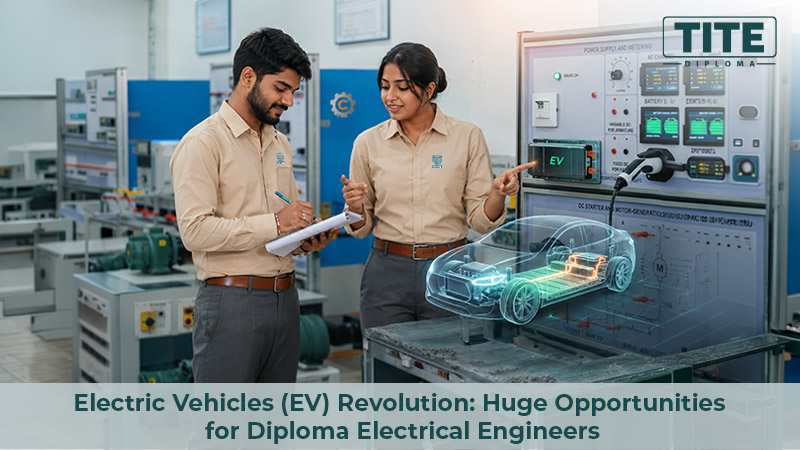
Electric Vehicles (EV) Revolution: Huge Opportunities for Diploma Electrical Engineers
Summary: The rapid adoption of electric vehicles is transforming the automotive and energy industries, creating unprecedented demand for skilled electrical professionals. Diploma electrical engineers are playing a vital role in EV manufacturing, battery management systems, charging infrastructure, testing and maintenance. With governments and industries investing heavily in sustainable mobility, this field offers excellent career growth, competitive salaries, and future-ready job opportunities.
The electric vehicle (EV) revolution is reshaping the global transportation industry, and India is emerging as one of the fastest-growing EV markets through supportive government initiatives, manufacturing incentives, and rapid expansion of charging infrastructure. As the country accelerates towards cleaner mobility, the demand for skilled electrical professionals continues to rise across EV manufacturing, battery technology, power electronics, and charging systems. Students exploring the Best electronics diploma colleges in Bhubaneswar have a unique opportunity to build industry-ready skills that align with this transformative sector. According to industry estimates, India's EV market is projected to witness exponential growth over the coming decade, while the government aims to significantly increase EV adoption across multiple vehicle segments by 2030.
For diploma electrical engineers, this transition represents much more than a new employment trend—it is the beginning of a future-proof career path. Their expertise in electrical circuits, motors, control systems, power distribution, and maintenance perfectly matches the technical requirements of the EV ecosystem, making them highly employable across manufacturing plants, battery assembly units, charging infrastructure projects, and service networks. Industry reports also indicate continued hiring for specialized engineering roles as EV investments expand across India. Students looking to prepare for these opportunities can begin by choosing a career-focused institution like TITE Diploma, where industry-oriented learning helps bridge the gap between classroom education and emerging technologies.
Why EVs Need Electrical Engineers
The rapid growth of electric vehicles has significantly increased the demand for skilled electrical engineers. Unlike conventional vehicles that rely heavily on mechanical systems, EVs are driven by advanced electrical, electronic and software technologies. Diploma electrical engineers possess the practical knowledge required to design, install, test, operate and maintain these critical systems.
- EV Drivetrain Electrification and Motor Control: Electric vehicles use electric motors instead of internal combustion engines. Electrical engineers are responsible for motor selection, speed control, torque optimization, regenerative braking systems and overall drivetrain efficiency to ensure smooth vehicle performance.
- Power Electronics and Battery Management Systems (BMS): The battery is the heart of an EV, and its performance depends on an efficient Battery Management System. Electrical engineers work on battery monitoring, cell balancing, thermal management, safety protection and power distribution to maximize battery life and reliability.
- On-board Chargers, DC–DC Converters, and Inverters: EVs require sophisticated power electronic components to convert and regulate electricity. Engineers develop and maintain onboard chargers, DC–DC converters for auxiliary systems and inverters that convert DC battery power into AC power for electric motors with maximum efficiency.
- Charging Infrastructure, Smart Grids, and Vehicle-to-Grid (V2G): As EV adoption grows, charging stations and intelligent energy management systems are expanding rapidly. Electrical engineers design and maintain fast-charging stations, integrate renewable energy sources, develop smart grid solutions and enable Vehicle-to-Grid (V2G) technology that allows EVs to exchange power with the electricity grid.
- Electronics, Sensors, and Embedded Systems: Modern EVs rely on numerous electronic control units, sensors, communication modules, and embedded systems for battery monitoring, motor control, safety features, diagnostics and connected vehicle technologies. Students pursuing their education from Electrical engineering diploma colleges in Bhubaneswar, Odisha gain hands-on exposure to these technologies, preparing them for careers in the rapidly evolving EV industry.
Essential EV Skills for Electrical Engineers
Employers in the electric vehicle (EV) industry seek diploma electrical engineers who possess a strong combination of technical knowledge, practical skills, and problem-solving abilities. As EV technology continues to evolve, companies prefer candidates who can adapt to new systems while maintaining high standards of safety and efficiency. Students graduating from Diploma in electrical engineering colleges in Odisha can significantly improve their employability by developing the following industry-relevant skills:
Power Electronics Fundamentals
A solid understanding of power electronics is essential for designing and maintaining EV power systems. Engineers should be familiar with DC-DC converters, AC-DC converters, inverters, switching devices, and Pulse Width Modulation (PWM) techniques that control power flow efficiently.
Electric Machines and Motor Control
Employers expect candidates to understand the working principles of electric motors such as Brushless DC (BLDC), Permanent Magnet Synchronous Motors (PMSM), and induction motors. Knowledge of motor drives, speed control, torque optimization, and regenerative braking is highly valuable.
Battery Technology and Battery Management Systems (BMS)
Since batteries are the backbone of electric vehicles, engineers should understand battery chemistry, charging and discharging characteristics, State of Charge (SoC), State of Health (SoH), cell balancing techniques, thermal management, and battery safety protocols.
Embedded Systems and Firmware Development
Modern EVs rely on embedded controllers for various functions. Basic programming skills in C/C++, familiarity with microcontrollers, embedded firmware development, and Real-Time Operating Systems (RTOS) help engineers work effectively with EV control units.
Control Systems and MATLAB/Simulink
Simulation and control system design have become integral parts of EV development. Employers value candidates who can model electrical systems, analyze performance, and design control algorithms using MATLAB and Simulink.
PCB Design and Electronics Troubleshooting
Practical knowledge of printed circuit board (PCB) design, electronic component selection, soldering techniques, circuit testing, and fault diagnosis enables engineers to support hardware development and maintenance.
Testing, Validation, and Diagnostic Techniques
Engineers should be comfortable using laboratory instruments such as oscilloscopes, multimeters, power analyzers, and battery testing equipment. Familiarity with CAN (Controller Area Network), OBD (On-Board Diagnostics), and EV diagnostic tools is increasingly important in manufacturing and service environments.
Safety Standards and Automotive Regulations
Working with high-voltage electrical systems requires a strong understanding of electrical safety practices and industry standards. Knowledge of relevant IS/IEC standards, automotive functional safety principles, insulation requirements, and workplace safety procedures ensures compliance while reducing operational risks.
High-Demand EV Job Roles for Diploma Electrical Engineers
The rapid expansion of the electric vehicle ecosystem has created numerous career opportunities for diploma electrical engineers across manufacturing, research, testing, charging infrastructure, and after-sales services. With the right technical knowledge and practical training, graduates from Private diploma electrical colleges in Bhubaneswar can pursue the following in-demand roles:
- Power Electronics Technician / Engineer: Design, assemble, test, and troubleshoot power electronic components such as inverters, converters and motor controllers used in electric vehicles.
- Motor Testing & Maintenance Technician: Handle the assembly, calibration, performance testing, preventive maintenance and repair of electric motors, ensuring reliable and efficient vehicle operation.
- Battery Technician / BMS Technician: Perform battery cell testing, battery pack assembly, Battery Management System (BMS) diagnostics, thermal monitoring and fault analysis to improve battery safety and lifespan.
- Charging Station Technician: Install, inspect, commission, and maintain EV charging stations, including AC chargers, EVSE equipment and high-power DC fast charging systems.
- Field Service Engineer: Provide on-site installation support, diagnose electrical faults, perform preventive maintenance, and resolve technical issues for EVs and charging infrastructure at customer locations.
- Test & Validation Technician: Conduct laboratory and real-world performance testing, endurance testing, electrical safety verification, CAN communication analysis, and data logging to validate EV components.
- Production / Assembly Supervisor: Oversee manufacturing operations, coordinate assembly lines, ensure production quality, manage technicians and maintain safety standards in EV manufacturing facilities.
- Quality Assurance & Compliance Assistant: Inspect EV components, verify product quality, perform compliance testing according to industry standards and maintain documentation for quality assurance processes.
- Embedded Firmware Junior Engineer (with Upskilling): Assist in developing, testing, and debugging low-level firmware for microcontrollers, battery management systems, motor controllers and embedded EV applications after acquiring additional programming skills.
Industry Certifications That Can Boost Your EV Career
While a diploma provides a strong technical foundation, industry-recognized certifications can significantly enhance your employability in the electric vehicle sector. These certifications validate your practical skills, keep you updated with emerging technologies, and make your resume more attractive to employers. Students pursuing Electrical diploma courses in Bhubaneswar Odisha can gain a competitive edge by earning certifications in the following areas:
- NIELIT (National Institute of Electronics & Information Technology): Offers certification programs in embedded systems, IoT, electronics hardware and industrial automation that are highly relevant to EV technologies.
- Automotive Skill Development Council (ASDC): Provides job-role-based certifications in electric vehicle service, maintenance, diagnostics, battery systems and automotive manufacturing, aligned with industry requirements.
- SAE India & SAE International Microcredentials: Specialized courses covering electric mobility, battery technology, powertrain systems, autonomous vehicles and automotive engineering fundamentals.
- Skill India / NSDC (National Skill Development Corporation): EV-focused training programs under various Sector Skill Councils, including courses on EV assembly, battery servicing, charging infrastructure and maintenance.
- Automotive Research Association of India (ARAI): Industry-recognized training programs on EV technology, battery testing, automotive electronics, functional safety and vehicle regulations.
- Siemens Technical Certifications: Courses on industrial automation, PLC programming, drives, digital manufacturing and smart energy systems that complement careers in EV production and charging infrastructure.
- ABB Learning Programs: Training in electric drives, power electronics, industrial electrification, motor control systems and EV charging technologies.
- Texas Instruments (TI) Training: Power electronics, embedded systems, microcontrollers, battery management systems (BMS), analog circuit design and motor control modules widely used in EV applications.
- Schneider Electric University: Certifications in electrical distribution, energy management, smart grids, and sustainable electrification, supporting careers in EV charging infrastructure.
- Rockwell Automation Certifications: Industrial automation, programmable logic controllers (PLCs), industrial communication networks and manufacturing technologies applicable to EV plants.
- Bosch Technical Training: Courses in automotive electronics, EV diagnostics, battery systems, sensor technologies and advanced vehicle servicing.
- MATLAB & Simulink (MathWorks) Certifications: Demonstrates proficiency in simulation, control systems, model-based design and electric powertrain development, which are widely used by automotive R&D teams.
- AutoCAD Electrical & Autodesk Certifications: Useful for electrical circuit design, wiring diagrams, control panels, and electrical documentation used in EV manufacturing.
- PCB Design Certifications (Altium Designer/KiCad/Cadence OrCAD): Valuable for engineers interested in developing electronic control units (ECUs), battery management circuits, and embedded hardware for electric vehicles.
Earning one or more of these certifications alongside a diploma can substantially improve technical expertise, increase placement opportunities and prepare aspiring electrical engineers for specialized roles in the rapidly growing EV industry.
EV Industry Landscape and Top Employers for Diploma Electrical Engineers
India's electric vehicle ecosystem is expanding rapidly, creating employment opportunities across manufacturing, component development, charging infrastructure, energy management and after-sales services. As EV adoption accelerates, organizations are actively recruiting skilled diploma electrical engineers who can contribute to production, testing, installation, maintenance and innovation. Students graduating from the Best electronics diploma colleges in Bhubaneswar can find career opportunities across the following industry segments:
- Original Equipment Manufacturers (OEMs): Leading two-wheeler, three-wheeler, passenger vehicle and commercial vehicle manufacturers are transitioning to electric mobility, creating demand for professionals in production, motor assembly, battery integration, quality assurance and vehicle testing.
- Tier-1 Automotive Suppliers: Companies that manufacture electric motors, Battery Management Systems (BMS), inverters, converters, controllers, wiring harnesses and power electronic components require skilled technicians and engineers for design support, testing, and manufacturing.
- EV Charging Infrastructure Companies & Power Utilities: Organizations involved in installing, operating and maintaining AC and DC fast-charging stations, smart grids, renewable energy integration and energy management systems offer excellent career prospects.
- EV Startups: The growing startup ecosystem provides exciting opportunities in EV conversion kits, battery-swapping technology, connected vehicle solutions, telematics, fleet management platforms, autonomous mobility and innovative battery technologies.
- Aftermarket Service Centers & Fleet Maintenance Companies: As the number of electric vehicles on Indian roads increases, specialized EV service centers, fleet operators, battery repair facilities and maintenance companies continue to hire electrical engineers for diagnostics, preventive maintenance, repair and technical support.
Salary Expectations and Career Progression
The salary of a diploma electrical engineer in the EV sector depends on factors such as technical skills, certifications, location, company size and hands-on experience. While fresh diploma holders generally begin in technician or diploma engineer trainee (DET) roles, continuous upskilling in areas such as battery management systems (BMS), power electronics, embedded systems and EV diagnostics can lead to faster promotions and higher salaries. Major automotive hubs such as Bengaluru, Pune, Chennai, Hosur, Sanand and NCR typically offer better compensation than smaller cities.
- Entry-Level (0–2 Years): Diploma Engineer Trainee (DET), Electrical Technician, Battery Technician, EV Service Technician, or Charging Station Technician typically earn ₹2.4–4.2 LPA (approximately ₹20,000–35,000 per month). Top EV manufacturers and Tier-1 suppliers may offer slightly higher packages to candidates with internships or relevant certifications.
- Mid-Level (3–6 Years): With practical experience and specialized skills, professionals can progress to roles such as Test Engineer, Service Engineer, Production Engineer, Quality Engineer, BMS Specialist or Service Team Lead, earning around ₹4.5–7.5 LPA.
- Senior-Level (6–10+ Years): Experienced professionals can move into positions such as Senior Engineer, Production Supervisor, Maintenance Lead, Team Leader, Quality Manager or Technical Trainer, with salaries generally ranging from ₹7–12 LPA, depending on the employer and responsibilities.
- Career Growth Opportunities: Diploma holders can further accelerate their careers by completing a B.E./B.Tech through lateral entry, along with industry certifications in EV technology, automation, embedded systems or power electronics. This opens doors to higher-paying roles in R&D, design engineering, product development, project management and technical leadership.
- Factors That Influence Salary: Compensation varies based on company, location, technical expertise, certifications, project experience, and communication skills. Professionals with expertise in BMS, CAN communication, MATLAB/Simulink, embedded systems and EV diagnostics generally command higher salaries than those with only conventional electrical engineering skills.
The electric vehicle revolution is not just transforming transportation—it is creating a new generation of career opportunities for technically skilled professionals. From battery technology and motor control to charging infrastructure and power electronics, diploma electrical engineers are becoming indispensable to the rapidly growing EV ecosystem. For students searching for Diploma in electrical engineering colleges in Odisha, choosing an institution that emphasizes practical learning, industry exposure and skill development can make a significant difference in long-term career success. If you're ready to build a future in one of India's fastest-growing industries, take the first step by submitting your online application and begin your journey toward a rewarding career in electric mobility.
-
-

-
.jpg) Mining Engineering Diploma Course With Practical Field Training August 21, 2026
Mining Engineering Diploma Course With Practical Field Training August 21, 2026 -
-